
Refacing · Refinishing · Owensboro, KY
Cabinet refacing and refinishing in Owensboro, Kentucky
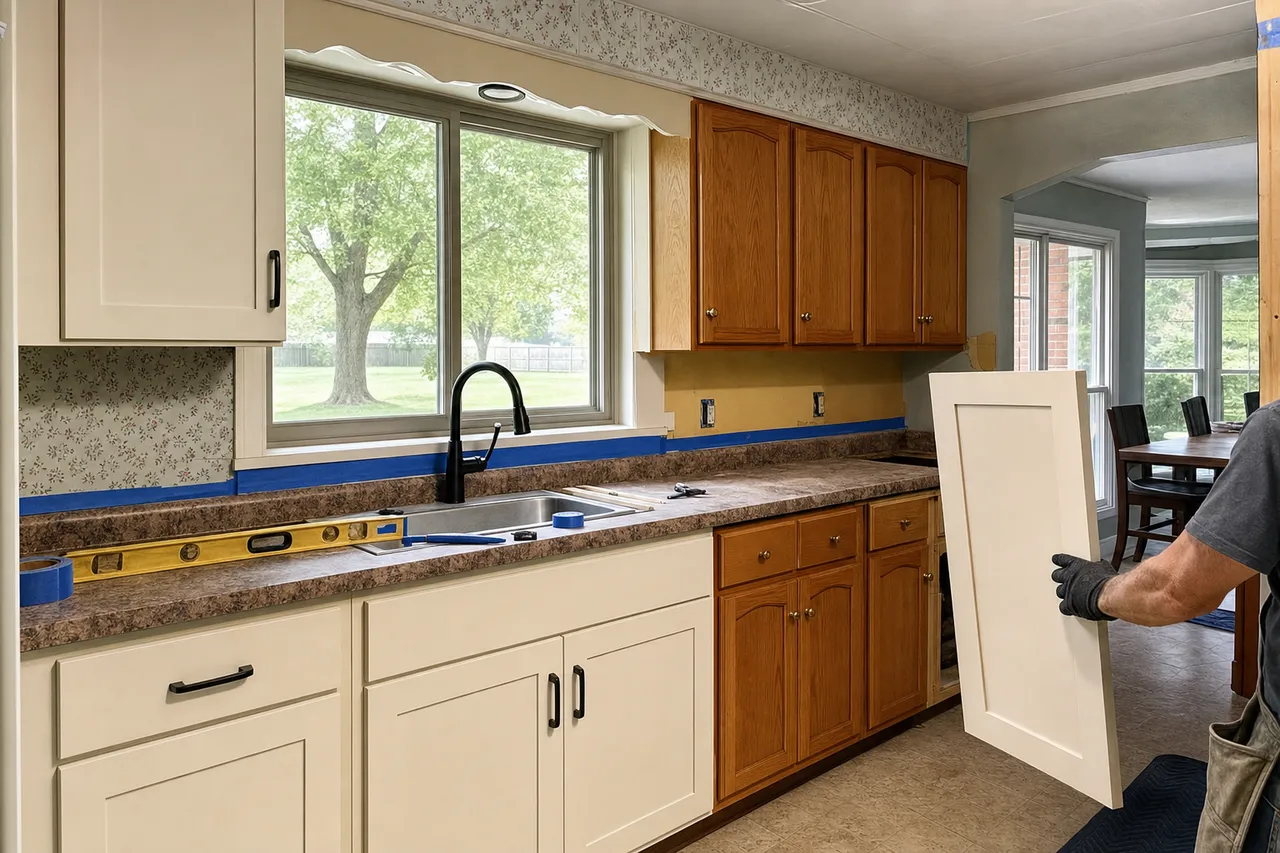
Owensboro is full of sound 1960s and 70s kitchen boxes wearing tired doors. New doors and veneer on the boxes you have, or a proper strip and spray of the ones you like, for a third to a half of what new cabinets cost, decided honestly after a look inside the sink base.
The short answer
Reface, refinish, or replace: which one does your kitchen need?
It depends on the boxes, and in this town the boxes are usually better than the doors. A big share of Owensboro's kitchens were built between 1960 and 1985, on site, by carpenters working out of plywood and birch. Those boxes are still square. What dates them is the door: the flat slab with the brass knob, or the honey-oak cathedral arch that went on every kitchen from Wesleyan Heights to Seven Hills around 1985.
Refacing keeps the boxes and the layout and gives you new doors, new drawer fronts, new hinges, and new veneer over every face frame and exposed end, so the finished kitchen reads as new. Refinishing keeps the doors too and changes the color, which is the honest route when the doors are solid wood and you were going to paint anyway. Replacement is for the boxes that fail the check, and for kitchens where the layout is the real problem. The cost page puts all three next to each other.
The putty-knife test
How to tell if your cabinets are worth refacing
Open the sink base. Take a putty knife or a butter knife and press it into the bottom of the box, then into the side panels down near the toe kick. Do the same under the dishwasher if the panel is reachable. You are looking for one of two answers.
Solid resistance, maybe a little paint flaking off the surface, means plywood or solid lumber. Those boxes will outlast the next set of doors and the set after that. Reface them. If the knife sinks in, or the bottom has puffed up and gone crumbly at the edges, that is particleboard that has taken water from a slow drain leak or thirty summers of humidity, and no veneer will fix it. That kitchen is a replacement, at least for the sink run.
The rest of the check is a straightedge across the doors to see whether the face frames are still flat, and a look at whether the drawers run on wood rails or metal slides. Wood rails can be replaced with soft-close slides during a reface; it is a line on the estimate and one of the better ones.
What a reface includes
What does kitchen cabinet refacing actually involve?
The word covers more than new doors. A reface done by a Daviess County shop is a set of steps, and the estimate should list each one.
-
Measure and door selection
Every opening is measured, because a 1971 kitchen was not built to a catalog. You pick the door style, the wood or the paint color, and the hinge type. Overlay doors are the usual choice on a reface; inset doors need a box built for them.
-
Doors and drawer fronts built in the shop
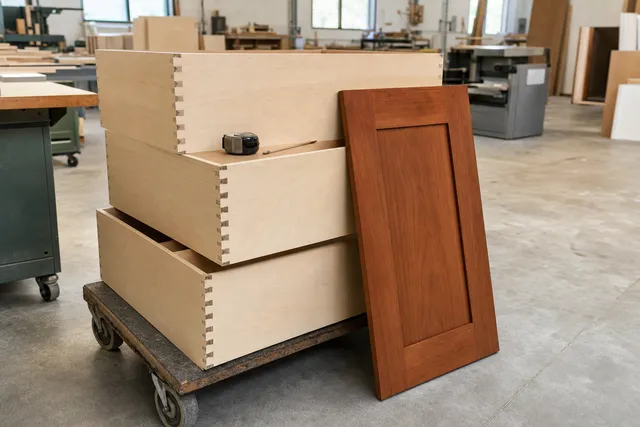
New doors in the species you chose, or in paint-grade maple sprayed in a finish room. Shaker, flat slab, or a raised panel if the house calls for it. Unfinished doors run $45 - $140 each before finish, which is why a reface is priced by the kitchen and not the door.
-
Veneer on the frames and ends
The face frames and any exposed end panel get a matching wood veneer or a sprayed finish, so the box and the door read as one piece. This is the step that separates a reface from a door swap.
-
Hinges, slides, hardware
Concealed soft-close hinges replace the old exposed ones. Drawers on wood rails can move to metal slides. New pulls go on last, and the holes from the old brass knobs disappear under the new fronts.
-
Two to four days on site
The kitchen stays usable. Doors come off, veneer goes on, doors go back. A crooked 1920s wall on Griffith Avenue or a soffit that was never square takes longer than a 1978 ranch, and the measure will say so up front.
Not sure which route? Start with the sink base.
Tell the cabinetmaker what the putty knife did, how many feet of run you have, and whether you are picturing paint or wood. That is enough for a range by route before anyone comes out.
The questions people actually type
Is it worth refacing cabinets?
When the boxes pass the check, yes, and in Owensboro they usually do. You get a kitchen that looks new for $4,500 - $11,000 instead of $8,500 - $18,000 and up, you keep the countertop, and the work takes days instead of weeks. It is not worth it over swollen particleboard, and it is not worth it when what you actually want is a different kitchen: an island where the peninsula is, drawers where the doors are, the soffit gone. Those are replacement reasons, and a shop that refaces and builds both will tell you which one you have.
What are the downsides of refacing?
Three honest ones. The inside of the box stays what it was, so a 1970s interior with a fixed shelf is still that, unless roll-out trays are added as a line. The layout stays, so a kitchen that never had enough drawers still will not. And veneer on a face frame is only as good as the prep under it; a frame that was brushed with three coats of paint over the decades has to come down to something clean before veneer will hold. None of those is a reason not to reface. Each is a reason to ask about it before the estimate is signed.
Refinishing versus refacing: which is right?
Refinish when you like the doors and want them a different color, and they are solid wood or a real veneer that can be sanded. Reface when the doors are the problem: a style you are tired of, a laminate that is peeling, cathedral arches on a house that deserves shaker. The cost gap between the two is real, so the honest question a cabinetmaker will ask first is whether you would keep the door if it were the right color. If the answer is yes, refinish.
Asked around Daviess County
Refacing and refinishing questions, answered plainly
How much does cabinet refacing cost in Owensboro?
A typical Owensboro kitchen refaces for $4,500 - $11,000, which works out to roughly $150 - $350 per linear foot of run. That covers new doors and drawer fronts, new veneer on the face frames and exposed ends, new hinges, and the install. Refinishing the doors and frames you already have runs $2,400 - $6,000. Both numbers assume the boxes pass the soundness check, and the written estimate names the door style and the finish.
Is refacing cheaper than replacing cabinets?
Usually a third to a half of new. Refacing at $4,500 - $11,000 against a shop-built galley at $8,500 - $18,000 and up is the comparison most Owensboro homeowners are making, and refacing wins whenever the boxes are sound and the layout is fine. It loses when the boxes are swollen particleboard, when you want drawers where there are doors, or when the kitchen needs a different footprint.
Can my cabinets be painted instead of replaced?
If the doors are wood or a good veneer, yes. The right way in this climate is a strip and spray: the doors and drawer fronts go to a shop and get sprayed in a finish room with a two-part paint, the frames get prepped and sprayed on site under masking. A brushed latex job over honey oak looks fine for a year and then chips at every edge, because the Ohio River valley swings from humid summers to bone-dry furnace winters and the wood moves under the paint.
How do I know if my cabinet boxes are good enough to reface?
Open the sink base and press a putty knife into the box bottom and the sides near the floor. Solid resistance means plywood or real wood, which most 1960s and 70s site-built Owensboro boxes are. If the knife sinks in, or the bottom is puffed up and crumbly, that is particleboard that has taken water, and refacing over it is money wasted. Check the box under the dishwasher the same way.
How long does cabinet refacing take?
Three to six weeks from the measure to the finished kitchen for a local shop, most of it waiting on the doors to be built and finished. The work in your house is two to four days: veneering the frames, hanging the new doors, fitting the drawer fronts. You keep using the kitchen the whole time, with the doors off for a few days.
Can one broken door or drawer be matched?
Often, if the finish is a common one. A single door built to match an existing kitchen is shop time at $65 - $110 an hour plus the door, and matching a thirty-year-old stain is the hard part. Bring the door itself, not a photo. If the finish is too far gone to match, refacing one run with the plan of doing the rest later is a fair middle path.
Written estimates, by the linear foot
Tell the shop what the putty knife found.
Roughly how many feet of run, what the doors are made of, and whether you want them replaced or repainted. That is enough to place the kitchen in a range by route, and the measure turns it into a written number. Prefer the phone? Call (270) 713-5984.
- Itemized on paper - boxes, doors, finish, hardware, install
- Measured against your walls, not a catalog size chart
- Built in a Daviess County shop by the cabinetmaker you meet