
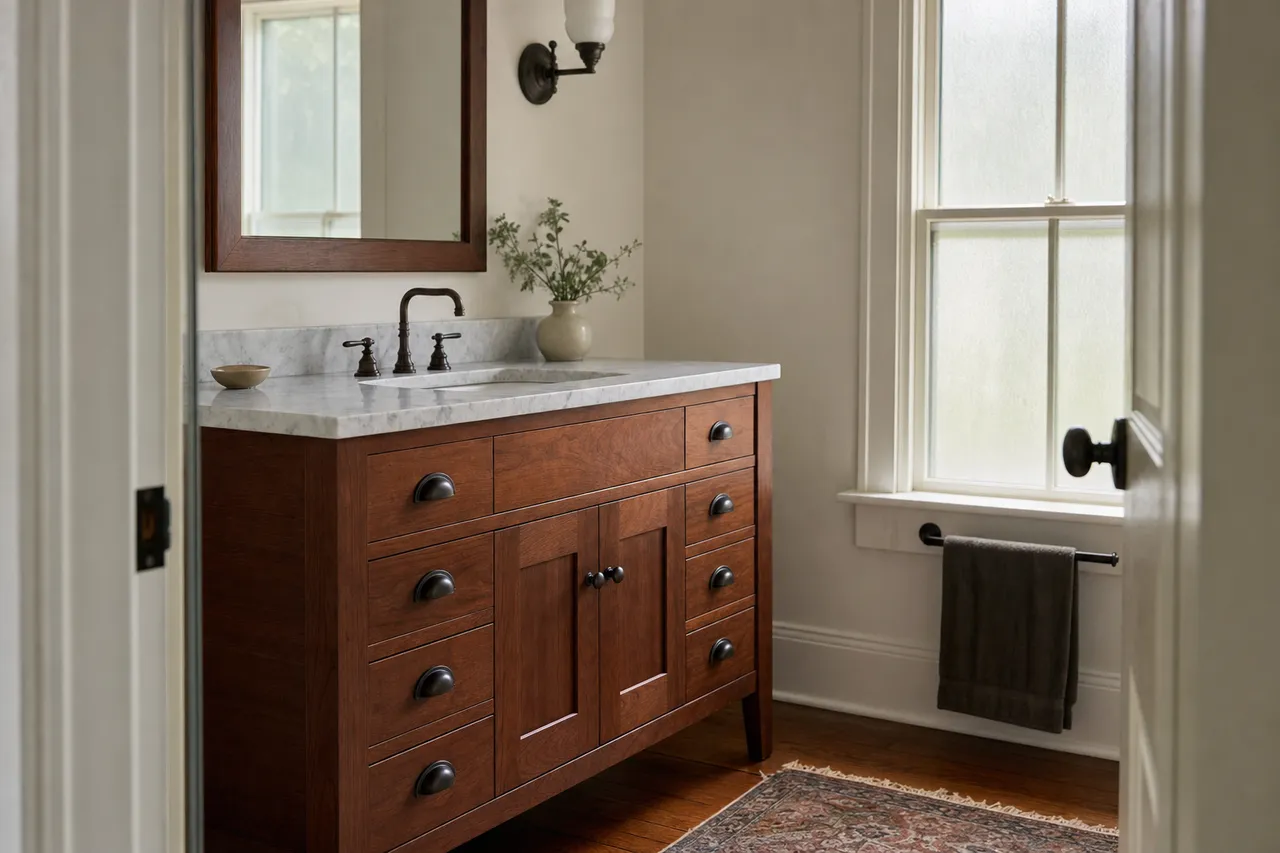
Bathrooms · Owensboro, KY
Custom bathroom vanities and cabinets in Owensboro, Kentucky
Vanities built to the width you actually have, out of plywood and Kentucky hardwood with a finish that shrugs off a steamy bathroom, plus the linen cabinets and built-ins to match. Priced in writing before the first board is cut.
The short answer
What is a custom bathroom vanity, and why have one built?
A custom vanity is a cabinet built to the wall it goes on. In Owensboro that usually means a 1960s or 70s bathroom with an alcove somewhere between 29 and 33 inches wide, a supply line that comes through the floor eight inches off center, and a store that sells vanities in 30 and 36. A Daviess County shop measures the alcove, builds the box to it, drills the plumbing cutouts where your pipes are, and sets it so the top meets the wall without a bead of caulk doing the work.
The other reason is the steam. A bathroom is the wettest room in the house, and a vanity lives eighteen inches from a shower. Plywood sides, a floating door panel and a sprayed catalyzed finish are what keep a vanity looking right through ten years of hot showers and a bath mat that never fully dries. A 48- to 60-inch shop-built vanity runs $1,600 - $4,800 with the finish included and the top excluded.
- Built to the alcove, to the quarter inch, with the wall's lean allowed for
- Plumbing cutouts made in the shop to your rough-in, not on your floor with a hole saw
- Plywood box, hardwood face frame, dovetailed drawers on soft-close slides
- Catalyzed finish sprayed in a booth, paint or stain
- Drawers around the sink trap so the storage is where the room needs it
- Installed and leveled by the cabinetmaker who built it
The same construction the shops use for a kitchen, explained on the custom kitchen cabinets page.
The bathrooms on these streets
Bathroom vanities for Owensboro's houses
The 1960s hall bath
Wesleyan Heights, Hillcrest, the ranch streets. One sink, a tub with a tile surround, and a vanity alcove that the builder framed to whatever was left over. A shop-built vanity with a bank of drawers beside the sink base gives a family bath the storage it never had, and a matching recessed medicine cabinet between the studs is the cheap upgrade nobody regrets.
The Griffith Avenue bath
Original hex tile or a 1940s pink-and-black floor, plaster walls, a pedestal sink someone is tired of. A furniture-style vanity on turned legs in cherry or painted poplar keeps the tile visible and suits the house. Inset doors with a beaded frame are the right call here and price at the premium tier, $1,000 - $1,600 a foot on longer runs.
The east-side primary bath
A new build off Highway 54 with a 72- to 96-inch double vanity wall and a builder-grade cabinet that was an allowance item. Two sink bases, a drawer tower between them, a full-height linen cabinet at the end, all in one species and one finish. This is where a bathroom stops being a fixture and starts being cabinetry.
Beyond the vanity
Custom bathroom cabinets: linen towers, built-ins and medicine cabinets
The vanity is the piece everyone prices. The cabinets around it are what make a bathroom work: a tall linen cabinet that replaces the towels stacked on the toilet tank, an over-the-toilet upper with doors that match the vanity, a medicine cabinet recessed into the stud bay so it sits flush with the wall, a low bench with drawers at the end of a tub deck. Built at the same time, in the same wood and finish, they read as one room instead of a set of purchases.
In a primary bath with a full wall to work with, the shop draws it the way it draws a kitchen: elevations, a story pole, and a written estimate by the piece. The construction is identical to the built-ins the same shops put in living rooms, scaled to a room with a fan running.
What the shops build for bathrooms
- Vanity
- Single or double sink base, drawer stacks, furniture-style or built-in, 24 to 96 inches
- Linen
- Tall cabinet, 15 to 24 inches wide, adjustable shelves, pull-out hamper if wanted
- Uppers
- Over-the-toilet or over-the-vanity, matched doors, lit or plain
- Medicine
- Recessed between studs with a mirrored door, or surface-mounted with a frame to match
- Tub & shower
- Bench with drawers, tub-deck cabinet, niche trim in hardwood
- Finish
- Catalyzed conversion varnish or two-part paint, sprayed; the same finish as the kitchen
Why the material matters in a bathroom
What a bathroom does to a cabinet in Owensboro
An Ohio River summer keeps the house humid for four months and a bathroom adds a shower's worth of steam on top of it twice a day. Then the furnace comes on in November and pulls the moisture back out. A vanity sits in the middle of that swing. Particleboard takes on water at the bottom edge where the mat sits, swells, and crumbles; a brushed paint job lifts at every joint as the wood moves under it. Plywood does not swell, a floating panel has room to move, and a sprayed catalyzed finish moves with the wood instead of cracking off it.
Species matters less than construction, but for a bathroom the shops lean on cherry, hard maple and painted poplar, all Kentucky hardwoods that dry stable and take a sprayed finish well. Which one suits a particular room, and which ones darken in a window, is in the wood guide. The three questions to ask any shop are the same as for a kitchen: what is the box, how are the drawers joined, and where is the finish sprayed.
The questions people actually type
Bathroom vanities in Owensboro, KY: store, dealer, or shop?
The store sells a box in 24, 30, 36, 48 and 60 inches and hands you a hole saw. The dealer orders a line in more widths and better plywood, built somewhere else, and sends an installer. The shop measures your alcove and builds to it. For a square new-build bathroom whose wall lands on a catalog width, the dealer is a fair buy. For the 31-inch alcove in a 1968 hall bath, the shop is the only one of the three that fits.
How wide should a custom vanity be?
As wide as the wall, minus a quarter inch a side for the scribe. A single-sink vanity works from 30 inches up; the sweet spot for drawers beside the sink starts at 42. A double vanity needs 60 at the least and is comfortable at 72. In an alcove, the shop builds the box a hair under the narrowest measurement and scribes the face frame to the walls, which is why a custom vanity has no gap at the wall and a store vanity has a bead of caulk.
Can the old vanity be refaced instead of replaced?
If the box is plywood and dry, yes, and it is cheaper. New doors and drawer fronts on a sound box, with the face frame veneered or painted to match, is the same work the shops do on kitchens. If the bottom edge is soft or the sides have bowed, the box is particleboard that has taken on water and there is nothing to reface. The refacing page has the test.
What does a custom vanity cost with the top?
The cabinet runs $1,600 - $4,800, and the top is the fabricator's number on top of that. Quartz and granite tops for a 48- to 60-inch vanity are usually a few hundred to a little over a thousand dollars depending on the slab and the sink cutout, and the fabricator templates after the vanity is set. The cost page lays out how the cabinet side of the number is built.
Measure the alcove. Get the vanity priced in writing.
The width between the walls, single or double sink, paint or stain. That places the vanity in a range on the phone, and the measure turns it into an itemized estimate.
Asked around Daviess County
Bathroom cabinet questions, answered plainly
How much does a custom bathroom vanity cost in Owensboro?
A 48- to 60-inch shop-built vanity in Daviess County runs $1,600 - $4,800 with the finish included and the top excluded. Smaller powder-room vanities come in under that, and a double vanity with two sink bases and a drawer tower runs above it. A tall linen cabinet or medicine cabinet built to match is its own line on the estimate.
Can a custom vanity be built to fit a narrow or odd-sized alcove?
That is most of the reason to have one built. The 1960s baths in Wesleyan Heights and Hillcrest often have a vanity alcove that measures 29, 31 or 33 inches between walls, and the store sells 30 and 36. A shop builds the box to the alcove, allows for the wall that is out of square, and puts the plumbing cutouts where your pipes actually come through the floor or wall.
What holds up in a bathroom that steams up twice a day?
A plywood box, a floating door panel and a catalyzed finish sprayed in a booth. Particleboard vanities swell at the bottom edge where the bath mat sits wet, and a brushed paint job lifts at the joints within a couple of years of showers. The pros this site connects you with build vanities out of the same materials as their kitchens, for the same reason.
Do you build bathroom cabinets besides the vanity?
Tall linen cabinets, over-the-toilet uppers, medicine cabinets recessed between the studs, a bank of drawers beside the tub, and full built-in walls in a primary bath are all standard cabinetry work. Matching the vanity in species, door style and finish is the point of having them built together rather than bought separately.
Does the vanity price include the countertop and sink?
No. The $1,600 - $4,800 range covers the cabinet, the finish, the hardware and the install. Stone, quartz and solid-surface tops come from a fabricator who templates after the cabinet is set, and the sink and faucet are yours to choose. The shop will tell you which top thicknesses and sink styles the cabinet is built to carry.
Furniture-style or built-in: which is right for the room?
Furniture-style vanities with legs and an open toe suit the older Griffith Avenue and downtown bathrooms with original tile floors, because the tile shows and the room feels bigger. A built-in with a toe kick suits a family bath that gets mopped and a primary bath with a long double run. The shop can draw both against your wall before you decide.
Written estimates, by the linear foot
Tell us about the bathroom. The number comes back in writing.
Hall bath or primary, the width you have to work with, single or double sink, and whether there is a linen cabinet in the plan. That is enough to start. The estimate arrives itemized with the wood and the finish named. Prefer to talk? Call (270) 713-5984.
- Itemized on paper - boxes, doors, finish, hardware, install
- Measured against your walls, not a catalog size chart
- Built in a Daviess County shop by the cabinetmaker you meet